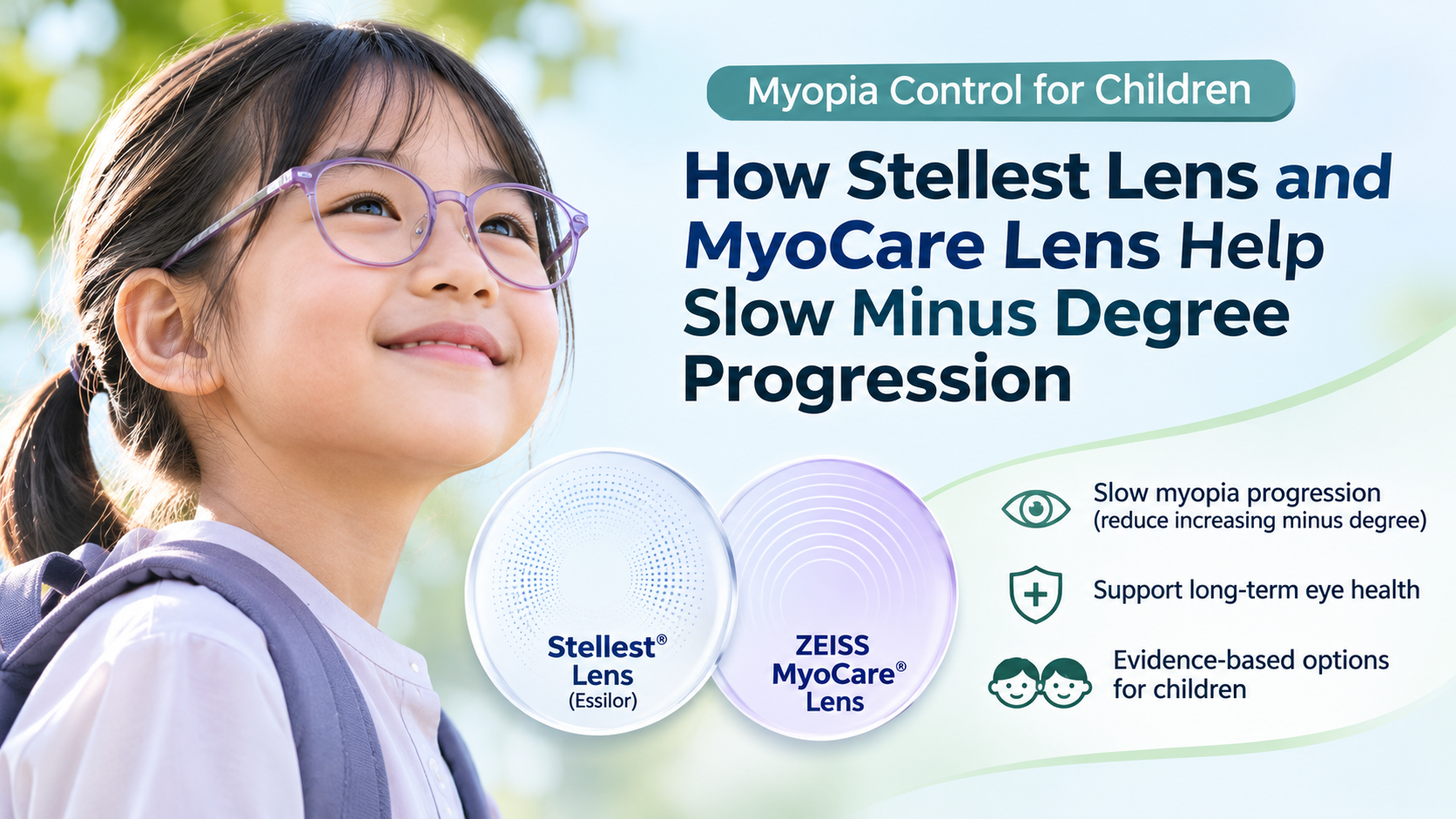
Myopia Control for Children: How Stellest Lens and MyoCare Lens Help Slow Minus Degree Progression
Does your child's spectacle prescription increase every year? If their minus degree keeps getting higher, it may be a sign of progressive myopia, commonly known as short-sightedness.
Myopia often develops during childhood and can continue progressing throughout the school years. Fortunately, modern myopia control lenses such as Essilor Stellest and ZEISS MyoCare are specially designed to help slow the progression of myopia in children.
At Apple To The Eyes, we believe managing childhood myopia is about more than providing clear vision today. It is also about helping protect your child's long-term eye health.
What Is Myopia and Why Does Minus Degree Increase?
Myopia, or short-sightedness, occurs when distant objects appear blurry while nearby objects remain relatively clear. It commonly develops when the eyeball grows too long, causing light to focus in front of the retina rather than directly on it.
As children grow, their eyes may continue to lengthen, resulting in an increasing minus degree. For example, a child's prescription may change from -1.00D to -2.00D or higher over several years.
Common signs of myopia in children include:
-
Squinting to see distant objects or classroom boards.
-
Sitting unusually close to televisions or screens.
-
Holding books or digital devices too close.
-
Complaining of blurred distance vision.
-
Frequently rubbing their eyes or experiencing visual discomfort.
Regular eye examinations help detect these changes early and determine whether myopia control treatment is appropriate.
Why Is Myopia Control Important for Children?
Traditional single-vision glasses help children see clearly but generally do not slow the progression of myopia.
As minus degree increases, the risk of developing certain eye conditions later in life also increases. These include retinal detachment, myopic macular degeneration, glaucoma, and cataracts.
Myopia control aims to reduce the rate at which a child's minus degree increases, rather than simply correcting blurry vision.
Although myopia control cannot guarantee that a child's prescription will stop changing, slowing progression may help reduce the likelihood of developing high myopia and its associated long-term risks.
Stellest Lens: Helping Slow Myopia Progression
Essilor Stellest lenses are specially designed spectacle lenses developed to help slow myopia progression in children.
They use innovative Highly Aspherical Lenslet Target (H.A.L.T.) technology, incorporating multiple rings of tiny lenslets surrounding a central clear-vision zone.
These lenslets create a specific optical signal intended to help slow excessive eye elongation while providing clear vision.
Clinical research has shown that Stellest lenses can significantly slow myopia progression compared with conventional single-vision lenses.
In a two-year clinical study, Stellest lenses slowed myopia progression by an average of 67% among children who wore them for at least 12 hours daily, compared with children wearing standard single-vision lenses.
Benefits of Stellest Lenses
-
Designed specifically for childhood myopia management.
-
Help reduce the rate of minus degree progression.
-
Provide clear vision for everyday activities.
-
Easy to incorporate into a child's daily routine.
-
Non-invasive alternative to contact lens treatments.
For parents looking for Stellest lenses in Miri, a professional eye examination can help determine whether this option is suitable for their child.
ZEISS MyoCare Lens: Another Option for Myopia Control
ZEISS MyoCare lenses are another innovative spectacle lens solution designed to help manage progressive myopia in children.
MyoCare lenses feature ZEISS Cylindrical Annular Refractive Elements (C.A.R.E.) technology, which combines a clear central vision zone with specially designed optical elements intended to slow excessive eye growth.
These lenses provide clear distance vision while introducing a myopia-control optical effect.
Clinical evidence supports their ability to slow myopia progression, although results vary depending on age, prescription, wearing habits, and other individual factors.
Benefits of ZEISS MyoCare Lenses
-
Designed to help slow childhood myopia progression.
-
Help reduce excessive eye elongation.
-
Provide comfortable vision for everyday activities.
-
Suitable for children who prefer spectacles over contact lenses.
-
Available in designs intended for different childhood myopia-management needs.
Both Stellest lens and MyoCare lens aim to slow increasing minus degrees, but they use different optical technologies.
The most suitable option depends on your child's prescription, age, eye measurements, visual needs, and professional assessment.
Other Myopia Control Treatments Available
Apart from specialized spectacle lenses, several other evidence-based approaches may help manage childhood myopia.
1. Orthokeratology (Ortho-K)
Ortho-K uses specially designed contact lenses worn overnight to temporarily reshape the cornea. Children can often see clearly during the day without spectacles, while the treatment may also help slow myopia progression.
2. Multifocal Soft Contact Lenses
Specialized myopia-control contact lenses provide clear vision while creating optical effects that help slow excessive eye growth. They may be suitable for children who can manage contact lenses safely.
3. Low-Dose Atropine Eye Drops
Low-dose atropine may be prescribed by an appropriately qualified eye-care professional to help slow myopia progression. Children will generally still require glasses or contact lenses for clear vision.
Each treatment requires appropriate assessment, monitoring, and consistent use.
Healthy Daily Habits to Support Myopia Control
Alongside myopia-control lenses, parents can encourage healthy visual habits.
-
Spend more time outdoors: Aim for approximately two hours of outdoor activity daily when practical.
-
Take regular screen breaks: Encourage the 20-20-20 rule during prolonged near work.
-
Maintain comfortable reading distance: Avoid holding books and devices excessively close.
-
Ensure adequate lighting: Provide comfortable lighting during reading and homework.
-
Schedule regular eye examinations: Monitor prescription changes and overall eye health.
These habits support children's visual well-being but should not be considered replacements for clinically recommended myopia-control treatment.
Myopia Control at Apple To The Eyes, Miri
At Apple To The Eyes in Miri, Sarawak, we understand that every child's eyes develop differently.
Our personalized eye examinations help parents understand their child's prescription, visual needs, and myopia progression.
Through professional consultation, we can discuss suitable options, including Essilor Stellest lenses and ZEISS MyoCare lenses, to help manage increasing minus degrees.
Regular follow-up examinations are important for assessing treatment response and making adjustments when necessary.
Take Action Before Your Child's Minus Degree Increases Further
If your child's glasses prescription becomes stronger every year, early myopia management may make a meaningful difference.
Stellest lenses and MyoCare lenses are designed to help slow myopia progression, not reverse existing minus degrees. Starting appropriate treatment early gives children more opportunities to manage their changing vision.
Book a children's eye examination at Apple To The Eyes, Miri, and let our team help you explore suitable myopia-control options for your child.